
AURA at ESCRS 2026: Advancing Evidence-Based Myopia Management with D.S.D.O. Lens Technology

At ESCRS 2026, one of the world’s leading congresses in ophthalmology and refractive care, AURA showcased its myopia management lens portfolio and hosted an expert-led scientific session focused on the evolving role of optical interventions in childhood myopia management.
As clinical practice moves toward earlier risk identification, evidence-based decision-making, and more individualized follow-up, AURA brought together international perspectives on myopia control, premyopia management, and the potential mechanisms through which optical designs may influence ocular development.
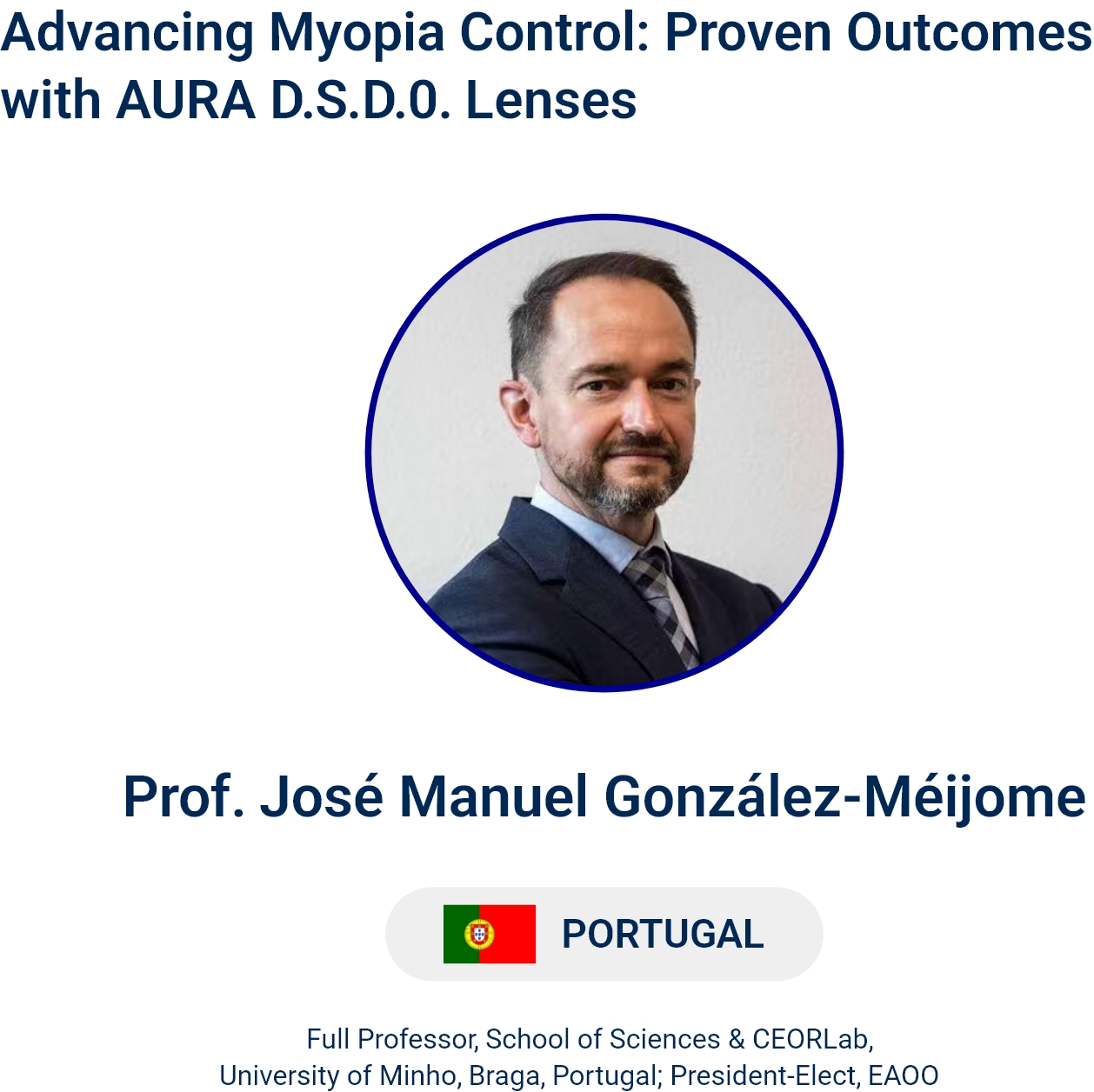
The session featured José M. González-Méijome, OD, PhD, who delivered a presentation entitled “Advancing Myopia Control: Proven Outcomes with AURA D.S.D.O. Lenses.”
International Expertise in Myopia Management
Professor González-Méijome is President of the European Academy of Optometry and Optics (EAOO). He is also a Full Professor of Optometry and Vision Science at the University of Minho in Portugal, Dean of the School of Sciences, and Head of the Clinical and Experimental Optometry Research Laboratory (CEORLab).
His research covers myopia management, contact lenses and visual optics, ocular biometry, retinal function, and clinical vision science. He also serves as Editor-in-Chief of the Journal of Optometry and contributes to international academic initiatives in myopia research and ocular surface science.
Beyond Defocus: The Importance of Optical Design
For myopia management spectacle lenses, the key is not only the presence of a defocus zone, but also how optical zones and defocus signals are distributed to balance clear everyday vision with myopia management objectives.
AURA D.S.D.O. lens technology applies a differentiated approach to optical zoning and defocus distribution, designed to provide children with clear vision while supporting a more targeted myopia management strategy.
During the presentation, Professor González-Méijome reviewed the clinical research foundation behind D.S.D.O. technology, including evidence published in international ophthalmic and optometric journals. He also emphasized that myopia management should not be evaluated by refractive change alone.
A comprehensive assessment should consider axial length, axial elongation rate, age, baseline refractive status, family history, myopia-onset risk, visual environment, treatment adherence, and long-term follow-up.
A Proactive View of Premyopia
A key focus of the session was premyopia—children who are not yet myopic but have an elevated likelihood of developing myopia based on age, refractive status, and other measurable risk factors.
Myopia onset is often preceded by early warning signs, including reduced hyperopic reserve, a refractive shift towards myopia, and accelerated axial elongation. This makes early risk identification, regular monitoring, and evidence-based communication with families increasingly important.
AURA D.S.D.O. lenses are currently the only myopia management spectacle lenses with publicly published clinical data in premyopic children wearing plano or plus-powered prescriptions. The published study demonstrated excellent outcomes, including a statistically significant reduction in axial elongation in children at risk of myopia onset.
These findings highlight the value of a proactive approach to myopia management—not only slowing progression after myopia develops, but also supporting earlier, evidence-based intervention during the premyopic stage.
Exploring the Biology Behind Optical Signals
Reliable clinical outcomes remain the foundation of myopia management. At the same time, understanding how optical designs interact with the visual system may help advance the scientific basis for more precise myopia management strategies.
Professor González-Méijome’s team shared retinal electrophysiology research related to different myopia management lens designs. Using full-field multifocal electroretinography and pattern electroretinography, the studies investigated changes in retinal bioelectrical responses under different experimental conditions.
The findings suggest that defocus-related stimuli may be associated with changes in inner retinal activity and peripheral retinal responses. Further research may help clarify the potential pathway linking optical defocus, retinal signaling, choroidal and scleral responses, and axial eye growth.
Looking Ahead
ESCRS 2026 provided an important international platform for AURA to engage with ophthalmologists, optometrists, researchers, and industry partners on the future of childhood myopia management.
Myopia management is not simply about selecting a pair of lenses. It requires early risk recognition, evidence-informed decision-making, appropriate fitting, patient education, and long-term follow-up.
AURA remains committed to addressing clinical needs through scientific evidence, continued clinical research, and collaboration with eye-care professionals worldwide. Through more precise and proactive myopia management strategies, AURA aims to help protect clearer vision and a healthier visual future for children and adolescents.