
From Landmark Publication to Global Leadership: The Evidence-Based Journey and Continuous Innovation of Aura Lenses
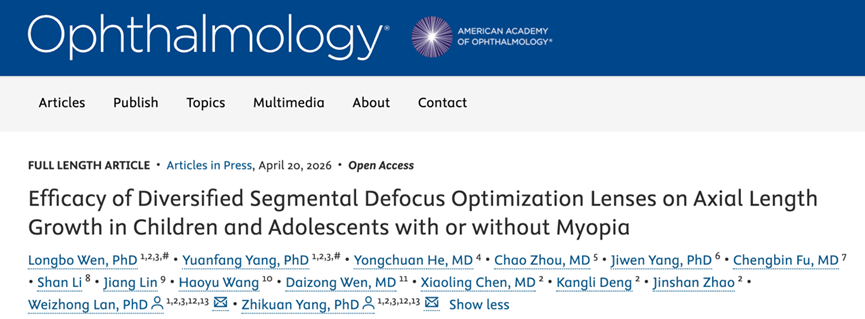
A milestone in myopia management was recently marked with the online publication of a pivotal clinical study in Ophthalmology, one of the world’s most prestigious eye journals. Led by Aier Eye Hospital Group, the prospective, multicenter, large-sample, real-world study conducted a head-to-head comparison between the DSDO spectacle lens “Aura,” developed and manufactured by Fitlens Medical, and the DIMS lens from Hoya Corporation. The results demonstrated that Aura successfully achieved superiority, showing a clear treatment advantage in controlling axial elongation.
Defining a New Paradigm with Real-World Evidence
The significance of Aura’s publication in Ophthalmology extends far beyond the superiority data. The study achieved multiple methodological breakthroughs: it was the first international attempt to perform a head-to-head comparison of myopia control spectacle lenses using a large-scale, multicenter, real-world study design—enrolling over 1,500 children and adolescents from eight centers nationwide and employing propensity score matching to balance baseline characteristics, thereby verifying Aura’s efficacy advantage in authentic daily clinical settings.
More importantly, the study demonstrated for the first time in a real-world setting Aura’s “prevention-integrated control” clinical value: among non-myopic children, those wearing Aura showed significantly slower axial elongation than untreated controls, meaning the intervention window for myopia control can be moved forward from “already myopic” to the “risk window.”
Built on Solid Ground: Aura’s Global Evidence Footprint
The high-profile publication in Ophthalmology is not an isolated event, but rather the culmination of years of systematic clinical research on Aura lenses. From short-term mechanistic explorations to long-term efficacy validation, and from randomized controlled trials to real-world evidence, Aura has constructed a complete and robust chain of evidence.
A 2025 study published in Ophthalmic and Physiological Optics, revealed the immediate mechanistic effects of DSDO lenses. In a study involving 60 myopic children who wore either Aura or single-vision lenses for 30 minutes of reading, results showed that wearing Aura induced significant axial length shortening and choroidal thickening within just 30 minutes, whereas single-vision lenses produced the exact opposite effect—axial elongation and choroidal thinning. This discovery provided direct physiological evidence for Aura’s optical design: by imposing myopic defocus on the mid-peripheral retina, rapid choroidal responses can be activated, thereby inhibiting axial elongation.
On the other hand, a randomized crossover study from the University of Minho, Portugal, published in Translational Vision Science & Technology, further explored Aura’s mechanisms at the neuroelectrophysiological level. The study concluded that different optical designs elicit characteristic retinal electrophysiological responses, and Aura, with its more widely distributed lenslet array, produced the most consistent changes in peripheral and inner retinal function. This study provided independent laboratory evidence for the advantages of Aura’s optical design at the level of retinal function.
In the domain of myopia prevention, a randomized, double-masked, placebo-controlled trial from Peking University People’s Hospital was published in JAMA Ophthalmology in 2025. The study enrolled 450 pre-myopic children aged 5 to 12 years, randomized to receive Aura plus placebo eye drops, Aura plus 0.01% atropine, or single-vision lenses plus placebo (control). The results showed that the 1-year cumulative incidence of myopia was 5.8% in the Aura group versus 15.3% in the control group; the proportion of participants with fast myopic shift was 15.7% in the Aura group versus 42.7% in controls. Notably, the addition of atropine did not further enhance Aura’s preventive efficacy, suggesting that Aura alone can provide effective preventive intervention for pre-myopic children.
From the immediate mechanisms shown in Ophthalmic and Physiological Optics to the retinal electrophysiology in TVST, from the myopia prevention RCT in JAMA Ophthalmology to the real-world validations in the Journal of Optometry and the Chinese Journal of Optometry & Ophthalmology, and culminating in the large-scale head-to-head confirmation in Ophthalmology—Aura’s evidence system spans the complete chain from fundamental mechanisms to clinical translation, a rarity among comparable products.
Anchored in Science, Going Global
Currently, Aura lenses have obtained EU CE MDR medical device certification, with an explicit indication for “myopia control and prevention spectacle lenses”—a rare feat among international peers to have “prevention” included in the certified indication. In addition, Aura has completed medical device registration in over ten countries, including Singapore, Canada, Vietnam, Indonesia, and Malaysia, steadily advancing overseas market access.